


Chip-on-Board LED: A Complete Guide to Next-Generation Lighting
Lighting technology continues to evolve, and LED modules... COB (Chip-on-board LEDs) represent one of the greatest advances in powerful and efficient lighting. If you are looking for high-quality lighting for commercial, industrial, or creative use, this guide simplifies everything.
What is a Chip on Board LED?
An integrated-chip (COB) LED is a lighting technology where many tiny LED chips are mounted close together on a single board. This forms a bright and uniform light source.
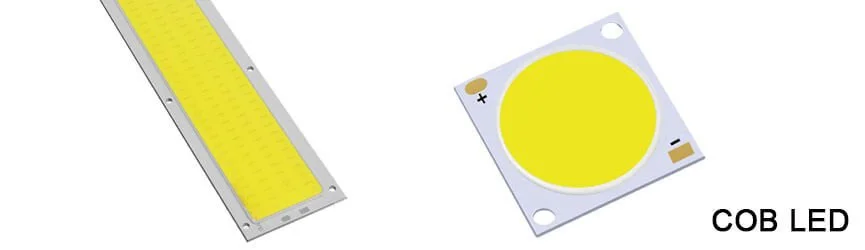
Advantages include:
- Greater luminous flux per watt
- Less heating
- Soft, shadowless lighting
- Longer lifespan
- More compact lighting design
This is why LED systems with COB chips (cob chip on board) are so highly praised in both the residential and industrial lighting markets.
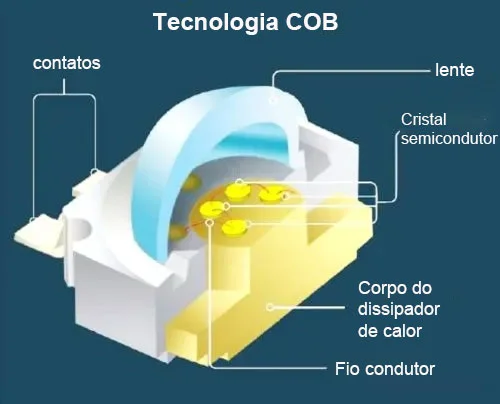
COB vs SMD vs DIPWhat is the best option for your lighting needs?
| Rresource | COB LED | SMD LED | DIP LED |
| Light emission | Continuous and uniform light | Bright, clear points with visible individual LEDs. | Bright lights with visible diodes |
| Efficiency | Very high (compact design, better heat dissipation) | Moderate (less efficient than COB) | Low to moderate (less efficient than COB and SMD) |
| Heat control | Excellent (best thermal management) | Good | Poor (less efficient at managing heat) |
| Applications | Spotlights, automotive headlights, architectural lighting | Residential lighting, TV backlighting, general use | Old technology, streetlights, and large display panels. |
| Shine | High | Moderate | High |
COB LED: Ideal for applications requiring high brightness, compact design, and excellent thermal management. LED modules with integrated COB chips provide uniform, high-intensity light, making them perfect for professional lighting systems.
SMD LED: These LEDs are commonly used in applications such as backlighting and residential lighting. Although SMD LEDs are smaller and more flexible, they are less efficient than COB LEDs in terms of brightness and heat management.
LED DIPAn older technology, DIP LEDs are still used in large-scale outdoor applications such as billboards and streetlights, but are being replaced by more efficient COB and SMD options.
Where do Chip-on-Board LEDs shine?
You can find LEDs with chip-on-board technology at:
- Lighting for photography and film
- High-quality spotlights and light tracks
- Car headlights and taillights
- Streetlights and industrial lighting
- Lighting scenic and architectural
Compared to standard LEDs, COB LED solutions with an integrated chip offer more power in a compact form factor, making them perfect for modern lighting setups.
Outlook for the Chip-on-Board LED Market
The market for chip-on-board LED technology is experiencing rapid global growth. Factors driving this growth include:
- Energy efficiency initiatives
- Increased demand for architectural lighting
- Expanding lighting for electric vehicles and automobiles.
- Peak lighting for home studios and creative projects.
Companies investing in COB (chip on board LED) technology, or assembling equipment for creative studios, find in COB LED solutions a performance that offers unparalleled brightness, efficiency, and professional-quality lighting.
Final conclusion
Whether you're modernizing commercial lighting or setting up creative studio equipment, chip-on-board LED solutions offer unparalleled brightness, efficiency, and professional-quality illumination.
With the rapid growth of the chip-on-board (COB) LED market, now is the perfect time to explore next-generation lighting technology.